

At a glance
- Sam Cook has nearly 350 first-class wickets at an elite average.
- England’s attack is searching for control after the Anderson-Woakes era.
- Cook’s accuracy and discipline may suit English conditions perfectly.
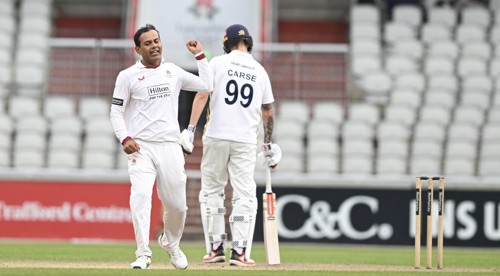
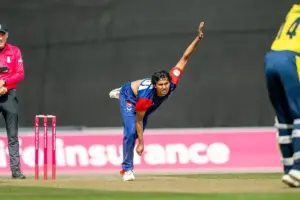
Sam Cook has spent most of his career existing in the space between recognition and selection. Every season seems to end with the same conversation: surely now England cannot ignore him any longer. Yet somehow they always have.
The numbers stopped being ordinary a long time ago. Nearly 350 first-class wickets at barely above 20 apiece. The first English bowler in half a century to pass 300 first-class wickets while keeping his average below 20.
Leading wicket-taker in this season’s County Championship before many attacks have even settled into rhythm. At 28, Cook is no longer a prospect waiting for development. He is a finished product waiting for trust.
And perhaps more importantly, he is exactly the kind of bowler England suddenly need again.
Follow: Read Cricket on Instagram.
England’s Attack is Changing After Anderson and Woakes
The retirement of James Anderson and the gradual fading of Chris Woakes has left England searching for the next identity of their seam attack. Under Ben Stokes and coach Brendon McCullum, England leaned heavily into pace, aggression and intimidation. It brought thrilling cricket and memorable victories, but Test cricket in England has always demanded something slightly different.
English conditions still reward patience more than theatre. In May and June the Dukes ball still swings beneath grey skies. Pitches still nibble. Batters still lose patience before bowlers lose discipline. For all the fascination with 90mph speedsters, there remains enormous value in a seamer who can place the ball on a sixpence for hours.
That is Cook’s craft.
He will not light up a speed gun. He will not bounce batters into panic. What he does instead is quietly relentless. He bowls the same probing line over and over until the mistake arrives almost through exhaustion. Then he repeats it to prove the dismissal was earned, not accidental.
Chelmsford has watched this routine for years.
Sam Cook Could be England’s Most Important Fast Bowler
Even Cook’s difficult England debut against Zimbabwe at Trent Bridge did little to change the argument for his inclusion. If anything, it reinforced it. On a flat surface, bowling in the low 80s, the margins became brutally small. England wanted him to be something different, and for a brief spell he tried.
Speaking to ESPNcricinfo, Cook admitted afterwards that he drifted away from the method that built his career:
“My biggest disappointment in that Test match was probably chasing wickets too much and going away from what I do well, which is just banging an area and holding it, and wearing batters down. I learned the repercussions for maybe going balls-to-the-wall a little bit too early, and trying a bit too hard.”
That honesty matters because it reveals the central misunderstanding around Cook. He is not supposed to be England’s next express quick. He is supposed to be their next metronome.
Australia’s recent Ashes triumph offered a reminder of how valuable that skill remains. While England chased raw pace, Australia won key moments through accuracy and relentless seam bowling from operators like Scott Boland and Michael Neser. Not glamorous. Just effective.
Cook belongs firmly in that tradition.
Why England Can No Longer Ignore Him
At Essex they call him “Little Chef”, partly because of the unavoidable link to Alastair Cook, the county legend who helped shape his career. Cook is the local lad who still understands that repeatedly hitting the top of off stump is not boring when it wins matches.
And it keeps winning matches.
This season’s 18 wickets are not the story on their own. The larger story is the consistency stretching across years. In the four seasons before his England call-up, Cook collected 200 first-class wickets at under 17 runs each. Even the ECB’s brief experiment with the Kookaburra ball barely slowed him down.
That sort of sustained excellence should eventually become undeniable.
Cook himself still speaks about England with enthusiasm rather than resentment, despite the frustrations of waiting. When criticism emerged around the relaxed nature of the current set-up, he openly defended it in his ESPNcricinfo interview:
“I took offence at some of the stuff that’s been reported, in that it’s too relaxed. Those top internationals, they’ve not there by accident, they’ve got there through doing hard work.”
There is maturity in those comments, just as there is maturity in his bowling now. At 28, Cook has reached the age where seam bowlers often understand their games completely. He knows what he is and, crucially, what he is not.
England should stop treating that as a limitation.
For years English cricket has searched obsessively for the extraordinary — the bowler with frightening pace, the unique release point, the impossible physical ceiling. Sam Cook represents something simpler but potentially more valuable: certainty.
He offers control. Patience. Movement. Reliability. The ability to make batting feel claustrophobic over long spells in English conditions.
And after years of hearing he is almost there, Cook is forcing England towards an uncomfortable possibility: maybe the answer has been sitting in county cricket all along.
Stay up to date with all the latest international cricket content with ReadCricket.



Comments.
Loading comments…