Great international careers rarely get the ending they deserve — elite sport is too unsentimental for that.
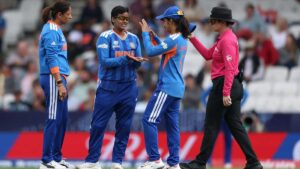
So it proved at Lord’s on Monday, where England’s 270-run defeat in the first women’s Test staged at the ground doubled as the farewell of two of the team’s defining figures. As Sky Sports and ESPNcricinfo reported when the announcements came last week, the historic match against India was the final international appearance for both Heather Knight and Tammy Beaumont, with Knight’s decision to retire after the Lord’s Test confirmed on the eve of the game. For supporters who watched this pair carry England’s women’s team into its professional era, the sight of them walking off together at the Home of Cricket — beaten, but garlanded — will linger far longer than the scoreline.
Yet, looking deeply at what the two leave behind, this is anything but a sad story.
What Heather Knight Leaves Behind
Knight retires as England’s most-capped player, with 320 international appearances and close to 8,000 international runs since her debut in 2010, according to Sky Sports. She took over the captaincy from Charlotte Edwards in 2016 and delivered the defining image of the era a year later, lifting the 2017 World Cup at Lord’s — the same ground that has now hosted her final act as a player.
Her next move is already mapped out. Sky Sports reported in December that Knight had been appointed London Spirit’s first women’s general manager, working alongside director of cricket Mo Bobat at the Lord’s-based franchise she captained to The Hundred title in 2024. With The Hundred beginning on 21 July, her second career starts barely a week after her first one ended.
Tammy Beaumont’s Opening Legacy
Beaumont’s numbers carry just as much weight. Per ESPNcricinfo, the opener made 260 England appearances after debuting in 2009 and retires as the country’s leading ODI centurion with 12 hundreds. Her peak came in the same golden summer as Knight’s: Player of the Tournament at the 2017 World Cup, where her 410 runs made her the competition’s leading scorer.
Between them, the two played across every phase of the England women’s team’s transformation — from amateur schedules to central contracts, packed grounds and a week at Lord’s billed as historic before a ball was bowled. That the farewell itself went India’s way does not diminish what made it possible.
Where Do England Women Go From Here?
The immediate picture is uncomfortable. Al Jazeera notes this was England’s fourth defeat in five Tests, and the manner of it — set a record 457, bowled out for 186, with only Amy Jones’ 54 and Sophie Ecclestone’s 50 offering real resistance — was as chastening as India’s stranglehold on the match had suggested it would be.
But transitions create room. The captaincy question is already settled, with Nat Sciver-Brunt having led the side at Lord’s, and the bowling attack around Ecclestone remains the envy of most Test rivals. The Hundred, starting on 21 July, now offers the next generation of England batters a month-long audition to fill two very large gaps at the top of the order.
England wanted this week to be remembered as the start of something. Instead it closes a chapter — and the rebuild that follows will decide whether the Knight and Beaumont years are remembered as a foundation, or as a high-water mark.