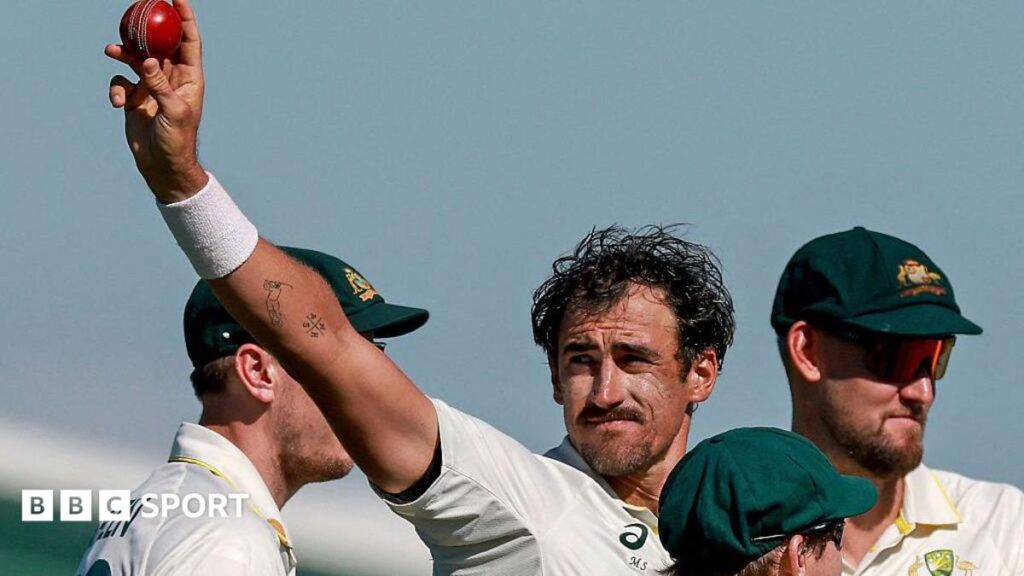

Mitchell Starc bowled the first ball of Bangladesh’s second innings in Mackay with a Test series to save, and by tea it was over. Australia’s left-armer added 4 for 39 to the 6 for 12 he had taken on Saturday, finished with match figures of 10 for 51, and Nathan Lyon took two wickets in three balls after the break to complete a win by an innings and 51 runs. The Australia v Bangladesh second Test lasted exactly 125 overs across two days, and it levelled the two-match series 1-1.
It was Starc’s fourth 10-wicket haul in Tests and, as BBC Sport noted from the Great Barrier Reef Arena, the fourth-shortest completed Test in which a side has won. It was also, according to ESPNcricinfo, the second-shortest Test ever played on Australian soil. Pat Cummins, whose 3 for 10 finished the job, was not entirely comfortable.
Australia v Bangladesh Second Test: The Two-Day Scorecard
Bangladesh were skittled for 64 on the opening day, Starc taking 6 for 12 and Cummins 3 for 25. Australia’s reply of 210 was hardly authoritative — Cameron Green top-scored with 67, Steve Smith made 42 and the left-arm paceman Shoriful Islam took 7 for 48 — but a lead of 146 proved more than enough. Bangladesh slumped to 24 for 3, were 95 for 8 at tea and folded to 95, Najmul Hossain Shanto’s 31 the only innings of substance and Mushfiqur Rahim left stranded on 29 not out. It was the first time Bangladesh have been dismissed for under 100 in both innings of a Test.
Australia’s own total was the fourth-lowest in Test history to secure an innings win. “It seemed to happen in fast-forward,” Cummins said, as the Guardian reported. “The pitch was pretty good. It didn’t really feel like a 30-wicket, five-session Test match, but it seems to be the way a few of these Test matches are going. There was some really good bowling in there at times, some below average batting — myself included.”
Three Two-Day Tests And A Batting Problem
Cummins was not exaggerating. This was the third time in the past seven Tests played in Australia that a match has finished inside two days, and the Sydney Morning Herald was among those arguing on Sunday that the trend is damaging the format. The counter-view is simpler: Australia’s batting has become a liability that their attack keeps rescuing.
Marnus Labuschagne, bowled for 4 in the first innings when Shoriful’s delivery cannoned off his thigh pad into leg stump, is averaging 24.69 since his last Test century in July 2023. Ricky Ponting’s verdict, reported by ESPNcricinfo, was that it is “well and truly time to look at somebody else” at No. 3. Australia lead the World Test Championship standings and top the Test rankings, yet they lost in Darwin to a side then ranked ninth, with an Ashes series in England to come in 2027 — the schedule for which has already caused its own row.
Bangladesh Go Home Sixth In The World
The visitors go home with the more remarkable statistic. Their nine-wicket win in Darwin last Sunday — described by the BBC as one of Test cricket’s greatest upsets — lifted Bangladesh three places to sixth in the ICC Test rankings, the first time they have risen above ninth, and to fourth in the nine-team World Test Championship table. It was their first Test tour of Australia in 23 years.
“To reach No. 6 in the Test ranking is a huge achievement,” Shanto told ESPNcricinfo. “It would have been better if we could have played better cricket in this Test match.” On Mackay he was blunter: “I don’t want to point finger at anyone in particular but we played poorly as a team.”
Starc, who has taken more Test wickets than any left-arm fast bowler in the game’s history, takes most of the credit for the correction, as he did when he reduced Bangladesh to 64 on Saturday. Whether a Test that produced 30 wickets in five sessions is a triumph for the format is a separate argument — and one Australian cricket seems to be having every few months.






Comments.
Loading comments…