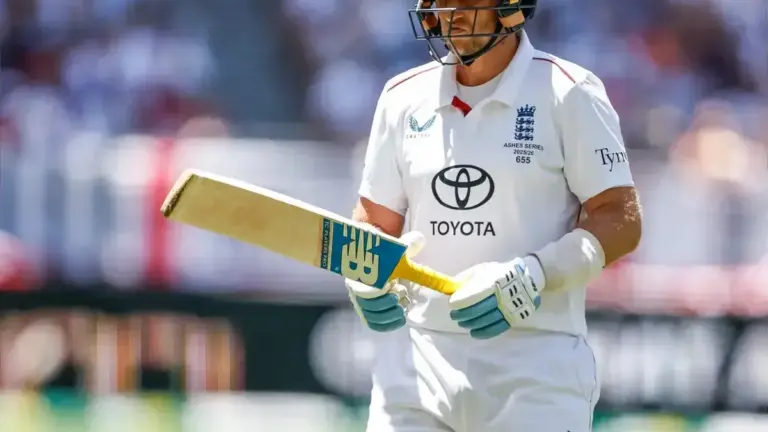
The Mark Wood retirement news landed on Tuesday. It closes one of the most thrilling pace stories English cricket has told this century. Wood is the fastest England bowler on record by most metrics, a title built on raw speed and a body that somehow kept finding another gear.
He described his fastest spells in an interview with the BBC in terms few bowlers ever use. “That was the fastest. I could be biased because I thought it was a breakthrough moment in my career. When I was watching the ball carry off the nicks, they felt a long way in the slips. You feel weightless. Like you’re never tired and are just picking up speed. It feels like you have all of this momentum and loose energy to release. You feel a surge through your body and then a whip out of your fingers.”
The Weightless Speedster Bids Farewell to Test Cricket
Wood’s career was never a straight line. Injuries interrupted it constantly, and supporters will remember his earlier fitness comeback targets as a recurring theme of his later years in the side.
Yet when fit, he offered England something no other seamer could. His extreme pace turned ordinary sessions into contests, forcing batters onto the back foot and opening the door for his team-mates at the other end. That physical gift, allied to his relentless spirit. Which is why his retirement is being felt so widely across the England set-up this week.
The Technical Shift: How Michael Holding Unlocked England’s Fastest Bowler
The numbers behind Wood’s early Test career tell a different story to the one supporters recall now. Across his first 12 Tests, his figures hinted at raw talent without the control to match it, a bowler still searching for the method to turn pace into wickets.
The turning point came through Michael Holding. The former West Indies fast bowler, one of the most feared quicks the game has produced, advised Wood to lengthen his run-up. It was a simple, specific piece of technical advice rather than a wholesale reinvention. It changed everything.
Wood used the lengthened run-up for the first time in the third Test against West Indies in Saint Lucia in 2019. He responded with 5-41 in the first innings. The clearest possible sign that Holding’s advice had unlocked something.
From that point, the bowler who had struggled for consistency in his opening dozen Tests became one of the most feared sights in world cricket. The extra run-up gave him rhythm and repeatable pace. County and international batters alike began to feel the difference.
Saint Lucia to Hobart: Statistical Proof of Wood’s Peak Impact
The Saint Lucia breakthrough was only the beginning. Wood’s best match figures, 9-100, came in the fourth Test against South Africa in Johannesburg in 2020, a performance built on serious pace.
He averaged 89.1mph across that game and helped England to a 191-run win. A result built almost entirely on his speed through the air. It remains the standout example of what Wood, at his fittest and fastest, could do in a Test match.
His best innings figures followed at the end of the 2021-22 Ashes, when he took 6-37 in the second innings of the final Test in Hobart. Australia had no answer to the short ball delivered at genuine pace. England had already lost.
Two years later, at Headingley in 2023, Wood produced another reminder of his ceiling. He took 5-34 in the first innings of the third Ashes Test, averaging 90.4mph on the opening day. Numbers that would have been remarkable from any bowler in the world, let alone an Englishman carrying a long injury history.
Legacy of Extreme Pace and the High-Velocity Future
Wood’s rivalry with Australia became part of his story, and it carried a genuine edge. Justin Langer, the former Australia head coach, later summed up the respect Wood earned from opponents in a single word: “respect.”
The needle ran both ways. Wood recalled the mood inside his own dressing room whenever Australia’s players got under his skin: “A few of the lads were desperate for me to stick one up him.” Australia’s supporters gave as good as they got, at times singing back at him: “Woody, we want to see you on.”
That back-and-forth, born of genuine competitive respect rather than needle for its own sake, is part of why Wood’s retirement carries such weight among England supporters. Pace bowling at his level is rare, and the game has increasingly rewarded bowlers willing to sacrifice control for raw speed, a trend visible across formats in high-velocity pace performances around the world.
England’s next generation of quicks now inherit a template. Holding’s advice to lengthen a run-up turned an average Test bowler into the fastest England has produced, and Wood’s Saint Lucia, Johannesburg, Hobart and Headingley spells stand as proof of what that technical adjustment made possible. Full detail on his career, in his own words, is available in BBC Sport’s interview with Mark Wood.