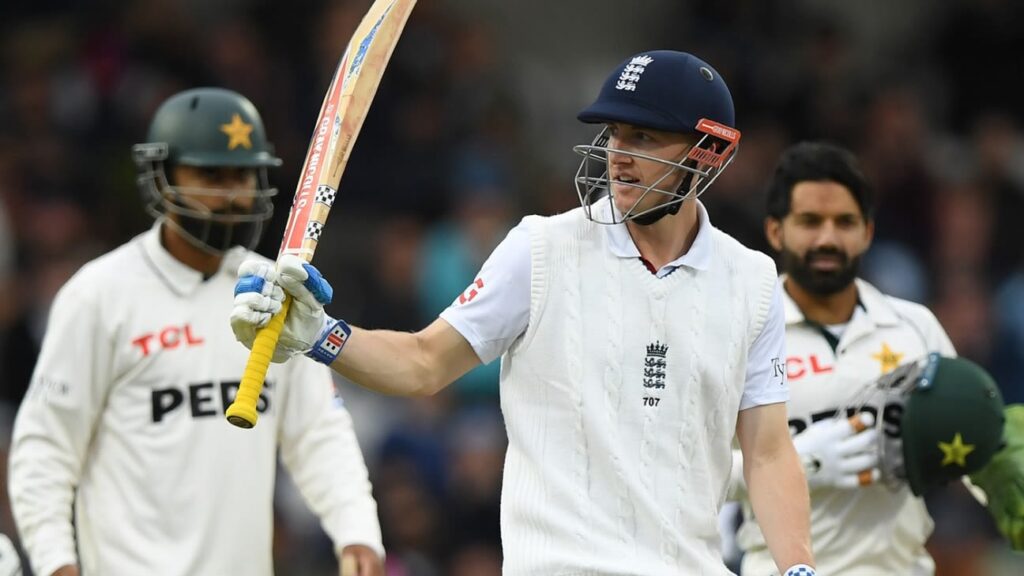

Harry Brook faced 93 balls at Headingley on Thursday afternoon and not once came charging down the pitch. He was dropped on one, accepted the reprieve without fuss, and worked his way to 91 in gloom thick enough to need the floodlights. For a batter whose recent reputation has been built on the shot he could not resist, the restraint was the story — and it arrived, as Jonathan Agnew pointed out, immediately after the Harry Brook Test captain question had been settled in somebody else’s favour.
Agnew’s verdict, written for BBC Sport, was unusually direct on both counts: Brook is among the most talented players he has watched in an England shirt, and he was not ready to lead the Test side. In a summer already reshaped by Ben Stokes’s retirement and Brendon McCullum’s removal from the red-ball job, that is no throwaway line. It is a working explanation of how England ended up back with Joe Root.
Why The Harry Brook Test Captain Case Was Turned Down
Brook was, by Agnew’s account, seriously considered by managing director Rob Key and others at the ECB before ultimately being overlooked. The reasoning was not tactical. “Yes, Brook has shown himself an able tactician and leader of the white-ball team,” Agnew wrote, “but at no point did I believe he was ready to be England’s Test captain.” The objection was maturity — Agnew cited the incident in Wellington and some of Brook’s past remarks to the media — and a job description that runs well beyond field placings, into representing the country and, when required, speaking on difficult subjects.
It is a distinction worth holding on to. Brook remains England’s white-ball captain across both formats and Root’s Test vice-captain. He was not judged unfit to lead; he was judged not ready to lead this side, in this format, yet.
The talent that was never in doubt
The praise was every bit as emphatic. “He is a very rare talent who ranks alongside the likes of Kevin Pietersen and David Gower as the most talented I have seen play for England,” Agnew wrote — a comparison that carries the frustration as much as the admiration. Gower and Pietersen could both make Test bowling look like a formality, and both, at times, hand it straight back.
Agnew’s complaints were specific and recent: Brook driving at Scott Boland in Perth, swinging at Mitchell Starc in Brisbane, on an Ashes tour that Mark Wood this week told Test Match Special he looks back on “shamefully”. Set against that, the 91 read like a different cricketer. “He will score a million runs if he keeps batting like this,” Agnew wrote. “It must be the blueprint for Brook across the rest of his Test career.”
What the innings did for England
The runs mattered beyond the argument. England closed day two on 366 for eight, a lead of 195, Brook’s 91 the highest of four fifties alongside Root’s 66, Jordan Cox’s 73 and Dan Lawrence’s 51, according to ESPNcricinfo. Pakistan’s lone comfort was the left-arm spinner Ali Usman, whose 5 for 92 brought a maiden Test five-wicket haul. Brook fell to him, beaten by an arm-ball, once again short of a hundred on his home ground — the subplot we picked up in our report on the innings.
So Root’s second tenure has opened with the tidiest possible arrangement: a captain doing the captaincy, a vice-captain doing the batting, each apparently content with the division of labour. Whether it holds into an Ashes summer in 2027 — by which point Stephen Fleming, described by the BBC as England’s incoming Test head coach, is expected to have taken over from the interim Marcus Trescothick — is the longer question.
Agnew’s answer, for now, is that Brook has been handed the best available response to being passed over, and that he has written it in 91 patient runs rather than a single word of complaint. Do it often enough and nobody else will need to reopen the captaincy conversation.
Comments.
Loading comments…